The Foundation of Performance
Just as an athlete must protect their body to perform at their best, a singer must look after their voice. The voice is our primary instrument for communication, and in a world where children are inspired by amazing vocalists, it’s more important than ever to understand how to use it healthily and safely. At Little Voices, we don’t just teach children to sing; we teach them to care for their most valuable tool.
Learning the Hard Way
This is a lesson I learned firsthand. As a young girl, I was completely immersed in the world of singing. From the age of eight, I was in multiple choirs, including the county youth choir, and I was singing practically seven days a week. At the time, I had a five-octave vocal range, and I was convinced I could hit every note in every song. A popular duet from Phantom of the Opera was a particular challenge, and I pushed my voice to its absolute limit to reach those high notes.
The result was a painful lesson. I strained my voice so badly that it became hoarse, and for six weeks, I had to stop singing and even speaking to allow it to rest. When my voice finally healed, it had settled into a comfortable mezzo-soprano range. Now, I know my limits, and if a note is outside my range, I simply don’t force it. This experience taught me that every singer, no matter how talented, must understand their own instrument and its boundaries.
Singing Smart, Not Strained
In today’s world, our children are listening to incredible K-pop artists who can hit impossibly high notes. While this is inspiring, it can also lead to vocal strain if children try to imitate without proper guidance. Many of those incredible notes are the result of years of professional training, and sometimes even technology. Most children’s voices are naturally in a mid-range and will not settle into a higher range, like a soprano, until their late teens.
At Little Voices, we teach children how to find their natural range and how to sing without shouting or screaming. Singing should feel comfortable and joyful, not painful. A comfortable note that comes out smoothly and without strain is a sign of a healthy voice.
Essential Vocal Hygiene
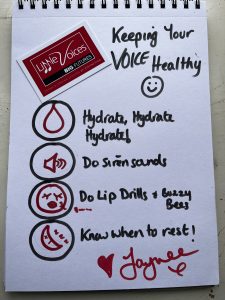
To truly look after your voice, you need to practice vocal hygiene. Just as an athlete stretches before a workout, a singer must warm up their voice before singing. Here are a few essential tips we teach our students:
- Hydrate, Hydrate, Hydrate! 💧 Water is your vocal cords’ best friend.
- Lip Drills: Make a “brrr” sound with your lips to relax your jaw and get your breath flowing.
- Siren Sounds: Gently slide your voice from a low, comfortable note all the way up to a high, comfortable note, and then back down again.
- Know When to Stop: If your voice feels tired or sore, it’s a sign to rest. Pushing through can cause long-term damage.
At Little Voices, we don’t just train voices; we protect them. We celebrate every voice, no matter its range, and we teach children to listen to their bodies and sing in a way that will allow them to enjoy singing for a lifetime. Our mission is to empower the next generation with the tools to express themselves creatively and confidently, while always prioritising their well-being.
Help your child be the best they can be!
Book A FREE TRIAL Book WORKSHOP REGISTER INTEREST GIFT VOUCHERInterested in finding out more, or being kept up to date?